(Samhain is coming, and the Temple doors are open for 30 days, free. Click here to join us for REBIRTH on November 1.)
There is a period of history that I think every woman should know about, because once I learned the truth of what happened, I never look at myself (or other women or the whole system) quite the same way.
I’m talking about the witch hunts in Europe, a period spanning roughly 200 years when tens of thousands, possibly hundreds of thousands, possibly more women were executed for witchcraft. The actual number is something I’ve been deep in the process of researching, and I don’t believe we’ll ever know the full extent of what happened (which is not an accident).
Sarah and I have been studying the erasure of the sacred feminine and its impact on women’s psychology for years, and we’re now writing a book about it. One of the most paradigm-shifting things I’ve come to understand through this work is that so much of what women experience as personal inadequacy, fear, shame, and self-doubt has roots in the systems of power that shaped our culture over thousands of years.
The witch hunts are one particularly brutal chapter of that history, and with Samhain approaching, I want to spend some time here.
Because my guess is there are things you have been afraid of your entire life without ever questioning why.
Let’s go back to Europe in the late 1400s.
At the time, religion, government, and economic power were deeply intertwined. The church held enormous political influence, and religious teachings were used to establish and enforce the rules of society.
There was also an enormous economic transformation underway.
For generations, communities had relied on shared land known as the commons. Families could access this land to grow food, raise animals, gather resources, and sustain their livelihoods. Women, including widows and unmarried women, could access resources through these communal arrangements without necessarily depending on a husband.
As land became enclosed and privatized, that arrangement began to disappear. Resources were being concentrated into fewer hands, wage labor was expanding, and the male-headed household was becoming increasingly central to economic life.
This is the backdrop against which the witch hunts unfolded.
In 1487, a book called the Malleus Maleficarum, or The Hammer of Witches, was published. It laid out a framework for identifying witches, describing their supposed relationships with the Devil, and prosecuting them.
It became enormously influential.
The church supplied the religious framework, including the idea that the Devil made pacts with people and that women were particularly susceptible to his influence. Courts carried out the accusations, arrests, torture, sentencing, and executions.
And the women who were most vulnerable were often those without the protection of a man.
Poor women. Older women. Widows. Women living on the fringes of society. Women who were isolated, who had become inconvenient, or who were simply accused by someone in their community.
Some were midwives and healers. Some practiced forms of folk spirituality. Many were ordinary women who had done nothing resembling what we would call witchcraft.
And in some circumstances, the people who accused a woman of witchcraft could seize her property. (Read that again).
Religion was being used to establish that certain women were dangerous or evil. The legal system was being used to remove those women through violence. And the economic system was changing in ways that made women’s independence increasingly difficult.
This was about land, money, power, and control. It was also about who had the authority to define what was sacred, what was evil, and which women were allowed to exist outside the protection and authority of men.
The historian Silvia Federici has written extensively about the relationship between the witch hunts, the enclosure of communal land, the control of women’s bodies, and the emergence of capitalism. Her work is one of the important lenses through which Sarah and I have been studying this period.
But there’s another dimension of this history that I want to bring into this conversation, because it’s the one that lives in us.
Imagine what it meant to be a woman during that time.
Imagine watching a woman in your community be accused, tortured, and killed. Imagine knowing that an accusation could come from a neighbor, someone you had angered, or someone who wanted access to what you had.
Imagine knowing that being different, being outspoken, being sexually expressive, practicing unconventional spirituality, or simply being a woman without the protection of a man could put you in danger.
And now imagine raising a daughter in that world.
What would you teach her about being safe?
What would you teach her about being liked? About standing out? About disagreeing with people? About expressing her anger or trusting her own authority?
What would you teach her about being a good woman?
And what would she teach her daughter?
This is how systems of power become internalized. Over generations, the rules of a society become the expectations of a culture, and those expectations become the beliefs we carry about ourselves.
Eventually, we no longer recognize them as beliefs we’ve inherited.
We experience them as who we are.
How many times have you described yourself as a people pleaser? How often have you said that you’re afraid of confrontation, that you don’t like being the center of attention, that you’re terrible with money, that you have a hard time asking for what you want?
How much of your life have you spent trying to be good, agreeable, accommodating, responsible, useful, and likable?
How often have you had an idea, a desire, or an instinct that you immediately dismissed because you were worried about what someone else would think?
And how many of those things have you accepted as permanent features of your personality?
In the Living Temple, we study six forms of internalized patriarchal conditioning: disconnection, compliance, worth, separation, powerlessness, and fear.
These are the psychological patterns that emerge when generations of people are taught to distrust their own experience, prioritize external authority, measure their value through service and sacrifice, and associate being different or powerful with danger.
The conditioning of fear is particularly relevant to the witch hunts.
This is the learned association between being different, sexually expressive, spiritually unconventional, ambitious, angry, or publicly powerful and the possibility of losing our safety and belonging.
Today, it can show up as shame, self-censorship, fear of judgment, and a reluctance to be visible.
And it is incredibly effective.
Because a woman who is afraid of being judged often stops herself long before anyone else has the opportunity.
She doesn’t share the idea. She doesn’t ask for what she wants. She doesn’t take the risk. She doesn’t say the thing she’s thinking. She doesn’t pursue the work that calls to her.
Sometimes she doesn’t even let herself acknowledge what she wants, because she’s already learned that wanting it might make her different.
This is internalized patriarchy.
The system no longer has to explicitly tell you what you are allowed to do. You have absorbed enough of its rules to begin enforcing them yourself.
And one of the most devastating places this happens is in our relationship to spirituality.
For centuries, the feminine face of the divine was systematically marginalized. Women were pushed out of spiritual authority. Practices associated with women’s relationships to their bodies, the earth, natural cycles, and their own experience of the sacred were suppressed or demonized.
The image of the spiritually powerful woman became associated with danger, corruption, and evil.
And that image is still very much alive in our culture.
I can tell you that I feel this conditioning in myself, even now.
I am a skeptic by nature. When Sarah first introduced me to the history of the sacred feminine, I questioned everything. I wanted to know where the information came from, what we could verify, and why I hadn’t learned any of it before.
I have since spent years studying this history and working inside the practices we’re talking about. I understand what we’re doing in ceremony. I know what it feels like in my own body. I’ve witnessed what happens when women begin reconnecting with their own authority through this work.
And yet there are still moments when I feel uncomfortable about how it looks.
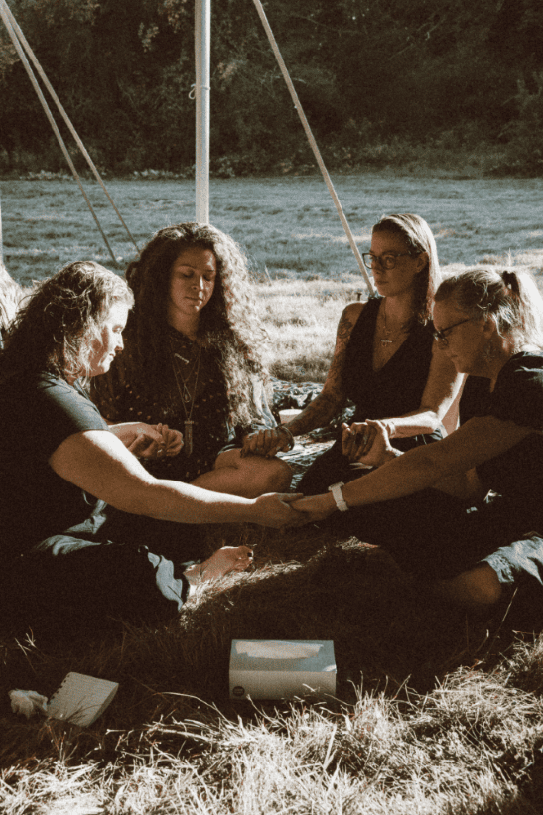
A red dress. An elaborate altar. A group of women gathered in ceremony.
I can feel myself anticipating the judgment of someone who doesn’t understand what we’re doing.
And I have to catch myself.
Because what exactly am I reacting to?
We’re working with meditation, movement, somatics, the cycles of the earth, our relationships with ourselves and each other. We’re creating space for women to examine their lives, listen to their own wisdom, and make conscious choices about how they want to live.
I know exactly what’s happening in these spaces, and still I can feel the conditioning telling me that something about it is strange, fringe, or even threatening.
That’s how deeply these associations can live in us.
And I wonder how many women have encountered something that genuinely interested them, something that stirred a recognition or curiosity, and immediately dismissed it because they were afraid of what it might mean about them.
What would people think if I did that?
What kind of woman would that make me?
Would people still respect me?
Would I still belong?
These are the questions I want us to become curious about.
Because what if some of the things you’ve spent your life avoiding are actually the things that would bring you into a deeper relationship with yourself?
What if the parts of yourself you’ve judged, hidden, or tried to make more acceptable are the very parts that carry your creativity, your authority, your desire, and your capacity to make change?
And what if your fear of those parts of yourself is something you learned?
This is why we have to understand our conditioning.
When you begin to recognize a belief or reaction as conditioning, you create the possibility of questioning it.
You can ask where it came from, who taught it to you, what it has protected you from, and whether it actually reflects what you believe.
You can begin to make conscious choices rather than automatically reproducing the expectations you’ve inherited.
And as you do, your life begins to change.
The woman who stops measuring her worth through self-sacrifice may begin changing how labor is distributed in her home. The woman who reclaims her authority may begin leading differently at work. The woman who stops fearing visibility may finally bring forward an idea or a body of work that changes other people’s lives.
This is why Sarah and I take this work so seriously.
The erasure of the sacred feminine was about much more than the loss of spiritual practices. It was the marginalization of an entire framework for understanding ourselves, our relationship to the earth, our relationship to each other, and how we organize society.
And the psychological consequences of that erasure are still being lived out in our homes, relationships, workplaces, and communities.
But here’s the thing to REALLY remember.
These systems were built by people.
The hierarchies, the laws, the economic arrangements, the cultural expectations, the stories about women’s worth and power. They were constructed over time, reinforced through institutions, and passed down through generations.
They are not our biological destiny. They are not the only way human beings have ever organized themselves. And they are not inevitable.
If people built these systems, people can change them.
And part of that work begins with becoming conscious of what we’ve inherited.
As we approach Samhain, a season when we turn toward our ancestors and the patterns we are ready to release, I want to invite you into an inquiry.
Think about the woman you were taught to be.
Think about the parts of yourself you’ve worked hardest to make acceptable, the desires you’ve dismissed, the things you’ve judged in other women, and the places where you’ve held yourself back.
Consider how much of that might be conditioning.
And then get curious about who you might be without it.
Love,
Kelly (& Sarah)
P.S. Sarah and I are opening the Living Temple for a free 30-day experience. If you’ve been curious about this work, you’ll be able to join us for Samhain Ceremony, our Moon gatherings, movement, and the community of women exploring these questions together.
We’d love to welcome you. Join the Living Temple free for 30 days.

Read the Comments +